Do You Need to Clean Your Solar Panels? (Real 2026 Soiling Data, With the Math)
Dirty solar panels lose 0.5% to 7%+ of their output depending on where you live. Here is the NREL-backed data, the cleaning cost math, and the rule that tells you when cleaning is worth it and when you should leave the panels alone.
If you have solar, you have probably wondered whether those panels need a wash. The honest answer depends entirely on where you live, what is landing on the glass, and what a clean is actually worth in dollars.
Most homeowners get this backwards. They either never clean, assuming the rain handles it, or they pay for professional cleanings that never break even. The truth sits in the middle, and it is almost always decided by one number you already know: your annual rainfall.
What "soiling" actually is
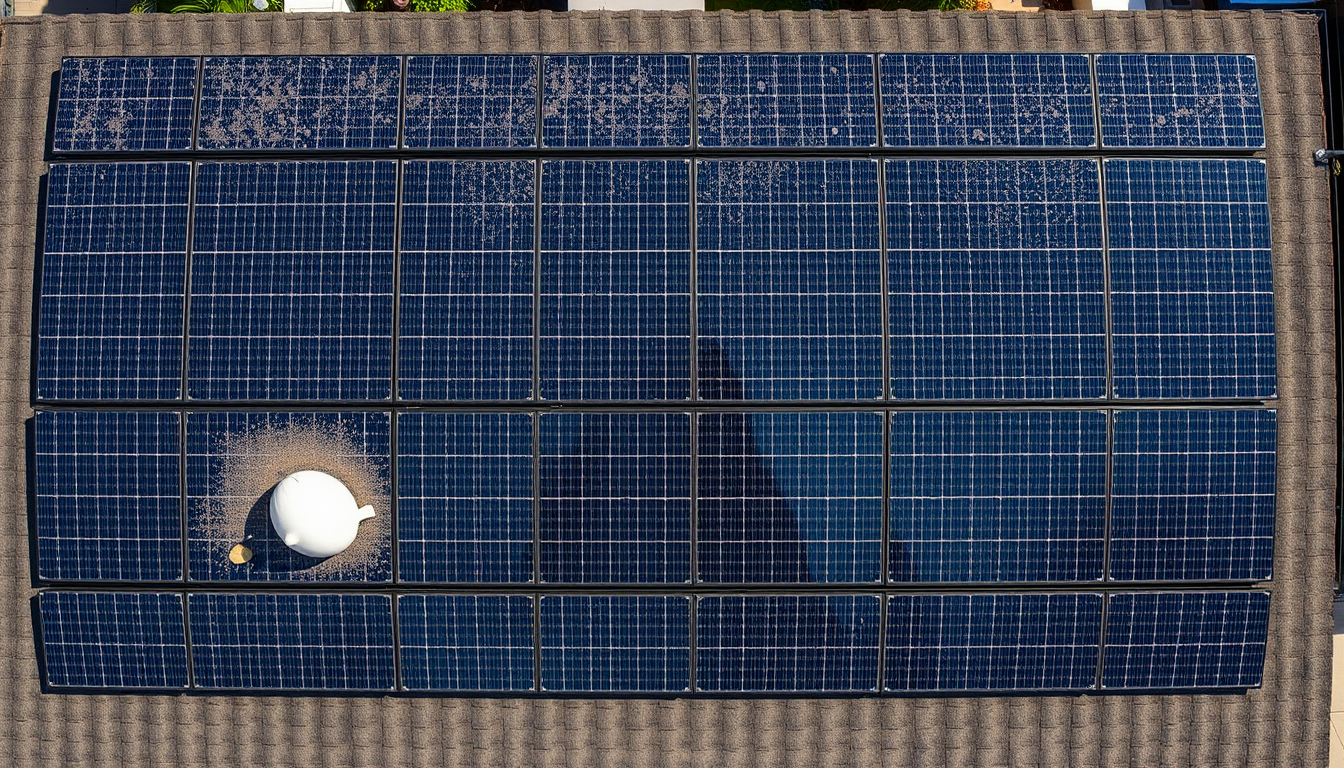
Soiling is the build-up of dust, pollen, bird droppings, sea salt, and pollution on the glass in front of your cells. It blocks light three ways at once:
- Absorption. Dust particles soak up some of the light before it reaches the silicon, turning it into heat. Dark sooty particles are the worst offenders.
- Scattering. Irregular particle surfaces bounce light at angles that miss the active cell area, so even a thin uniform film costs more than its coverage suggests.
- Shadowing. Large particles such as pollen grains and bird droppings cast hard shadows. A single bird dropping can shut off 100% of the output of the one cell it covers.
There is also a quieter second penalty. Dirty panels run hotter because the dark dust converts light to heat. A heavily soiled panel can run 7 to 12 degrees Celsius warmer, and since silicon cells lose roughly 0.4 to 0.5% of efficiency per degree above 25C, a bad case stacks a 3 to 5% thermal loss on top of the blocked light.
The single biggest variable: where you live
The location of your roof matters far more than any cleaning method. The dominant natural cleaning mechanism is rain, and the practical threshold is about 20mm (0.8 inches) of rainfall per month. Climates that clear that line consistently stay surprisingly clean on their own.
NREL has measured soiling at hundreds of field sites across the United States and quantified it with the insolation-weighted soiling ratio (IWSR). An IWSR of 0.95 means 5% of annual energy is lost to soiling. The pattern is consistent: arid, low-rainfall regions lose roughly 3 to 7% a year from soiling alone, while humid, high-rainfall regions lose under 1 to 2%.
Here is what that looks like in practice, with no cleaning intervention at all:
| City | Annual rainfall | Typical annual soiling loss | Dollar impact (10 kW system) | | --- | --- | --- | --- | | Las Vegas, NV | 4.2 in | 5 to 8% | $215 to $345 | | Phoenix, AZ | 7.6 in | 4 to 7% | $170 to $300 | | Fresno, CA | 11 in | 5 to 9% | $215 to $390 | | Los Angeles, CA | 15 in | 3 to 6% (dry season) | $130 to $260 | | Denver, CO | 14 in | 2 to 4% | $85 to $170 | | Dallas, TX | 37 in | 1.5 to 3% | $65 to $130 | | Seattle, WA | 39 in | 0.5 to 1.5% | $22 to $65 | | Miami, FL | 62 in | 0.5 to 1.5% | $22 to $65 |
(Dollar impact assumes a roughly $0.15/kWh rate on a 10 kW system producing 13,000 to 14,000 kWh a year. Adjust the rate for your state.)
Read that table twice. A homeowner in Phoenix faces several times more soiling loss than one in Seattle. For the desert Southwest, soiling is a real financial line item. For the Pacific Northwest or the humid Southeast, it is nearly a footnote.
Not all dirt is equal
The composition of what is on the glass matters as much as the amount.
- Desert dust (Arizona, Nevada): dry, coarse, washes away with 60 to 80% of a good rain, but accumulates fast where it barely rains at all.
- Urban soot and pollution film (LA basin, Houston, Chicago, NY/NJ): a sticky, hydrophobic oily layer that rain does not remove and needs a mild detergent.
- Pollen (tree-heavy and farmland zones, March to May peak): very sticky, resists light rain, and can cost 2 to 5% during peak weeks.
- Bird droppings: the most disproportionate loss per area. One dropping on a panel can cut that single panel 20 to 30% if it sits over the cell junctions. This is where your inverter type matters: in a single string inverter, one badly soiled panel drags down the whole string, while microinverters or optimizers contain the loss to that one panel only.
When is cleaning actually worth it?
The math is simple and it flips by scale and location.
Annual cleaning benefit = system annual kWh x soiling loss % x your $/kWh rate
Annual cleaning cost = cost per clean x cleans per year
Net benefit = benefit minus cost
Work it out for Phoenix. A 10 kW system losing 5% a year to soiling is giving up about 900 kWh, worth roughly $122 at local rates.
- Professional cleaning twice a year at $175 a visit costs $350. Net: negative $228. The service loses money.
- DIY cleaning four times a year, with a soft brush, a telescoping pole, and non-abrasive water, costs almost nothing after a one-time $50 to $150 in gear. Net: positive, roughly the full $122 every year.
The break-even point for a professional visit is a soiling loss that exceeds the visit cost. In a dry climate that is a threshold most 6 to 8 kW residential systems never cross. For a Phoenix homeowner, the right move is DIY a few times a year, not a service contract. In Seattle, the right move is to leave the panels alone and let the rain do the work.
If you do clean, clean right
Wrong technique costs more than the dirt. Pressure washing, abrasive scrubbing, hard tap water, and cleaning in midday heat scratch the anti-reflective coating, leave mineral films, and trigger thermal shock. Studies find these habits can add 0.3 to 0.5% of permanent degradation per year while you think you are maintaining the system. The safe approach: early morning or evening when the glass is cool, a soft non-abrasive brush, deionized or distilled water (never hard tap water), and no pressure. For bird dropping calcification, soak first, then wipe.
The practical takeaway
You do not need to become a soiling scientist. You need to know your climate and your numbers. A few rules of thumb cover almost everyone:
- Humid or rainy climate? Rain is your cleaning system. Check the glass once or twice a year and wash only if you can actually see a heavy film.
- Arid climate or near a farm? Soiling is real. DIY clean in the dry months, and make sure a single panel being soiled does not drag down the rest of your system (microinverters or optimizers help).
- Never pressure wash, never hard tap water, never midday heat.
- Bird problems near water, cliffs, or trees? That is the one spot where a targeted professional clean can pay for itself.
And the deeper point: soiling is one of the losses that quietly shrinks the savings you were promised, and the only way to know whether it is meaningful for your specific roof is to start from your real production number and your real local rate. That is the same foundation a proper solar assessment starts from.
If you have not run the numbers on your own home yet, it takes minutes. A $19 SolrScan satellite scan tells you your address's real annual sunshine hours, how many panels actually fit your roof, the system size and cost, and your projected savings, so you can see exactly how much a few percent of soiling is worth in your context before anyone quotes you. Scan your home at https://solrscan.com.
SolrScan estimates are based on satellite imagery and public data. Consult a licensed installer for a site-specific assessment.