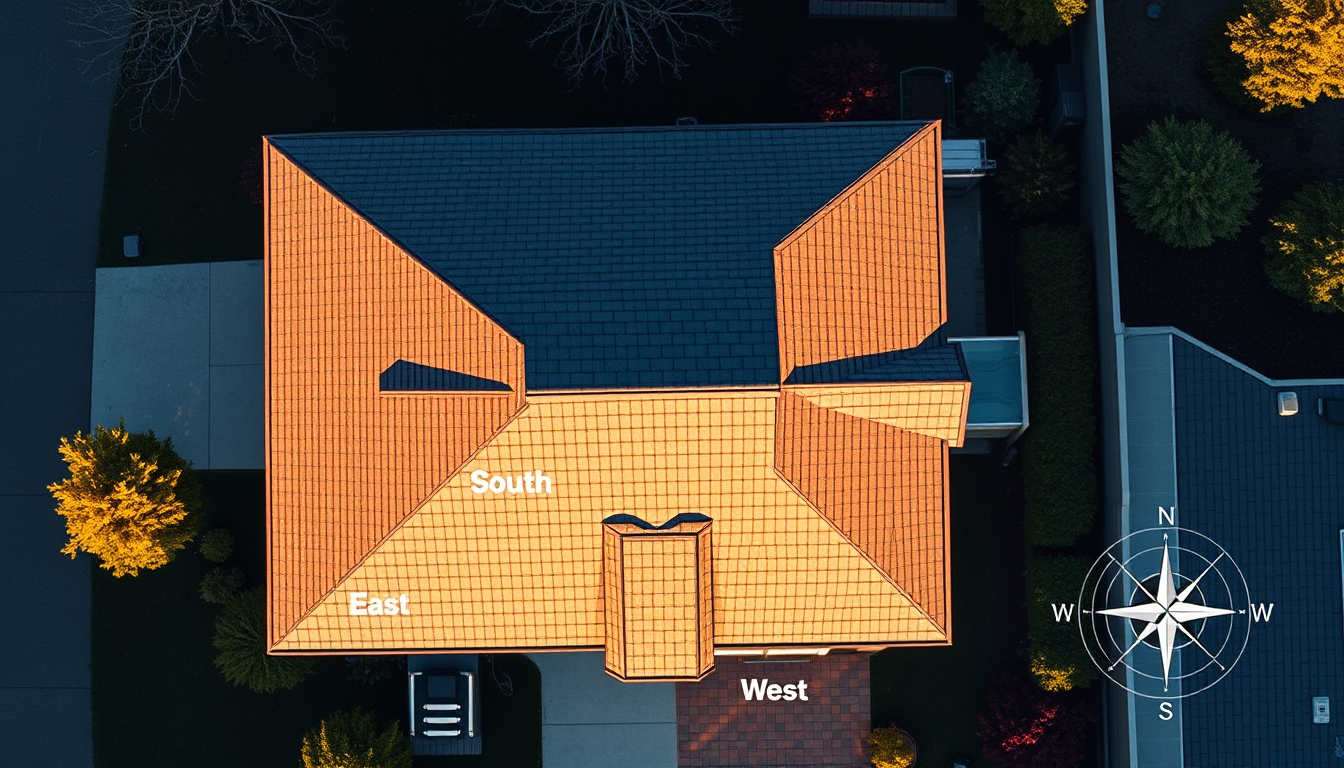
Does Your Roof Face the Right Way? How Direction Changes Your Solar Output (With Real Numbers)
South-facing is the textbook answer, but the penalty for east, west, or even north is far smaller than most people assume. Here is how much each direction actually costs you in kilowatt-hours and payback, and when a "bad" roof is still a great solar bet.
Ask a homeowner about solar and they often say the same thing: "My roof doesn't face south, so I probably can't do solar."
It is the most common self-disqualification in the industry, and most of the time it is wrong.
The real question is not "does it face south?" It is "how much does my direction actually cost me, and is what remains still worth it?" Once you see the numbers, you will usually find that your roof is far more workable than you thought. Here is what the data actually says.
Direction matters, but not as much as people believe
In the Northern Hemisphere the sun tracks across the southern sky, peaking directly south at solar noon. So a true south-facing array catches the most direct light for the longest stretch of the day. That is the baseline, and it delivers 100% of your potential output.
But the penalty for anything else is smaller than the "south or bust" lore suggests. Modeled across real roof configurations with NREL's PVWatts tool, annual production by direction looks like this:
- True south: 100% (baseline)
- Southeast / Southwest: 95% to 98%
- East / West: 75% to 90%
- Northeast / Northwest: 60% to 78%
- North: 50% to 85%, depending on roof pitch and latitude
A panel angled 30 to 45 degrees off due south (southeast or southwest) is basically there. The real-world difference between southeast and true south is often smaller than the measurement error in most production estimates. If your roof faces that way, stop worrying. You have effectively won.
East vs. west: it is about when you use power, not just how much
East and west roofs produce roughly 75% to 90% of a south-facing system. But they trade some total energy for something south cannot give you: production that matches when you are actually home.
A south array peaks at noon, when many houses are empty. An east-facing array peaks around 7 to 11 AM. A west-facing array peaks 1 to 5 PM, right when air conditioning kicks in and many utility companies charge their highest time-of-use rates.
That timing matters financially. A kilowatt-hour you consume at 5 PM under peak rates is worth more than one you export at noon for a low feed-in rate. In markets with time-of-use pricing (like California's NEM 3.0), a west-facing system can deliver better real savings than a south-facing one, even with lower total output. West generally produces 5% to 10% more total energy than east and lines up with afternoon peak demand, making it the default choice for time-of-use customers.
The Atlanta payback example makes this concrete. For a typical 7 kW system at $0.13/kWh:
- South (100%): about 10,000 kWh/year, 9-year payback
- Southeast / Southwest (96%): about 9,600 kWh, 9.5 years
- East / West (87%): about 8,700 kWh, 10 years
- Northeast / Northwest (75%): about 7,500 kWh, 12 years
- North (70%): about 7,000 kWh, 13 years
The gap between south and east/west is about one year of payback. That is a very acceptable trade, not a dealbreaker.
North-facing: bad reputation, overblown fear
North-facing roofs get the worst name, but they are not solar dead zones. How bad north actually is depends on two things: roof pitch and latitude.
NREL-modeled data for Charlotte, North Carolina (latitude 35.2 degrees) shows the gap is pitch-driven:
- 4.8 degree (1/12) pitch: north loses only 8% vs south
- 9.5 degree (2/12) pitch: north loses 16%
- 18.4 degree (4/12) pitch: north loses 29%
On a shallow, low-pitch roof, a north-facing array can reach over 80% of south output in summer months, because the sun rides higher and farther north in the sky. North-facing systems tend to work in the deep South (Florida, Texas, Arizona, southern California) where the sun stays high year-round, and fail to pencil out in the Northeast and Pacific Northwest where direct sun at that angle is too scarce.
The general rule: avoid a north-only roof if you have any south, east, or west exposure with real capacity. If north is truly your only option in a sunny state, it can still be viable with the right incentives. If you are in a northern state with no better face, a ground mount is usually the better move.
The two things that quietly beat direction: split roofs and shade
Two details matter more than the compass heading most homeowners fixate on.
First, most homes do not have one big south-facing plane. They have a split roof: south plus east, or east plus west. That is totally workable, but it changes your inverter choice. A single string inverter spanning two orientations loses production to mismatch. Microinverters (like the Enphase IQ8) or power optimizers (like SolarEdge) optimize each panel independently and are essentially required for split-orientation homes.
Second, shading from trees or a neighboring roof will cost you more than almost any directional compromise. Partial shade from a single tree can knock 10% to 25% off an array. Direction is a fixed number; shade is a leak you may be able to fix.
What to do next
You probably do not need to talk yourself out of solar over a roof you have only ever seen from the ground. You need to know your actual orientation, pitch, and shade before you size a system.
SolrScan does that for you. For $19, it scans your home with satellite imagery and returns a solar potential report: your annual sunshine hours, how many panels actually fit, recommended wattage, estimated install cost, and projected savings. No appointment, no sales call, just the numbers for your specific roof.
Scan your home at https://solrscan.com and find out whether that roof you keep dismissing is quietly one of the good ones.
SolrScan estimates are based on satellite imagery and public data. Consult a licensed installer for a site-specific assessment.