How Many Solar Panels Do You Actually Need? (The Math That Installers Hope You Skip)
Most "how many panels" quotes are a guess. Here is the exact formula designers use, real state-by-state peak sun numbers, and three worked examples that show why your roof and your zip code matter more than the headline panel count.
"How many solar panels do I need?" is the first question almost everyone asks. And it is the question most quotes answer the worst.
A driveway estimate often lands on a round number, or whatever fits neatly on the roof, or whatever makes the system bigger. That is not sizing. Sizing starts with your own electricity bill and your own zip code. This guide walks through the exact formula professional designers use, so you can check whether a quote is honest.
The formula (it is not hard)
Two equations do all the work:
System size (kW) = Annual kWh usage / (365 x peak sun hours x derate factor)
Number of panels = System size (kW) x 1,000 / panel wattage
There are four inputs. Get them right and you will be within a few percent of what professional design software produces.
Input 1: Your annual electricity use (from your bills, not a guess)
Add up twelve months of kWh. Your utility app usually shows this directly. Do not take one month and multiply by twelve, because a summer of air conditioning or a winter of electric heating will skew the number badly in either direction.
Rough anchors if you have nothing else: a small apartment runs 2,000 to 4,000 kWh a year, an average family home runs 4,000 to 9,000 kWh, and a large home with electric heating, a pool, or an EV can exceed 15,000 kWh. The U.S. average household uses about 10,500 kWh per year (EIA).
One thing most people miss: size for the future, not the past. An electric car adds roughly 2,000 to 4,000 kWh a year. Adding those panels at the original install costs far less than a second visit later, and your roof space and inverter headroom are both finite.
Input 2: Peak sun hours (the number everyone gets wrong)
Peak sun hours are not daylight hours. One peak sun hour is one hour of sun at the reference intensity panels are rated at (1,000 W per square meter). A spot can have fourteen hours of daylight in June but only five or six peak sun hours, because early and late sun is weak and oblique.
This is the single biggest lever in the whole equation, and it is almost entirely decided by where you live. NREL-derived state averages range from about 6.5 peak sun hours a day in Arizona down to about 3.2 in Alaska. That is more than a 2x difference for the exact same panel.
A few reference points from NREL PVWatts data:
- Arizona: 6.54 PSH (about 1,755 kWh per kW per year)
- California: 6.08 (about 1,677)
- Colorado: 5.66 (about 1,595)
- Texas: 5.22 (about 1,421)
- U.S. average: 4.98 (about 1,367)
- New Jersey: 4.66 (about 1,305)
- New York: 4.50 (about 1,291)
- Washington: 3.95 (about 1,088)
- Alaska: 3.17 (about 922)
Notice the spread: a panel in Phoenix produces more than twice the energy of the same panel in Anchorage. Your zip code does more work in this math than your panel brand.
Input 3: The derate factor (the honest number)
Panels never deliver their nameplate rating in the real world. The derate factor bundles all the real losses into one multiplier:
- Heat (cells run hotter than test conditions): 5 to 12%
- Inverter conversion: 2 to 4%
- Wiring losses: 1 to 3%
- Soiling and dust: 2 to 6%
- Module mismatch: 1 to 3%
- Shading (site specific): 0 to 20% or more
- Year one degradation: 1 to 2%
A safe number for most installs is 0.75 to 0.80. Drop to 0.70 or below if you have real shading, a hot climate, or a poor roof orientation. If a quote uses a derate above 0.85, it is being optimistic. If it ignores derating entirely, it is overstating production by a quarter.
Shading is the one input that is truly unique to your roof, and it is the one you cannot read from a national table.
Input 4: Panel wattage
Residential panels in 2026 commonly run from 400 W to 600 W. Higher wattage means fewer modules and less hardware for the same output, which helps when roof space is tight. On a small roof, efficiency (watts per square foot) matters more than on a big one.
Three worked examples
Example A: Small home, 800 kWh/month, moderate sun
9,600 annual kWh, 4.5 peak sun hours, 0.78 derate, 450 W panels:
9,600 / (365 x 4.5 x 0.78) = about 7.5 kW. That is 17 panels, or roughly 34 square meters of roof.
Example B: Family home, 1,200 kWh/month, high sun
14,400 annual kWh, 5.8 peak sun hours, 0.76 derate, 550 W panels:
14,400 / (365 x 5.8 x 0.76) = about 8.9 kW. That is 17 panels again, roughly 44 square meters.
Look at that. This home uses 50% more power but ends up with the same panel count, because the sun works harder. Location does as much in this equation as usage does.
Example C: Large home with an EV, 2,000 kWh/month, low sun
24,000 annual kWh, 3.4 peak sun hours, 0.74 derate, 500 W panels:
24,000 / (365 x 3.4 x 0.74) = about 26 kW. That is 53 panels, roughly 116 square meters.
At this point roof area, not budget, is the constraint. This is exactly where offsetting only part of your use may be the sensible call, and where high-efficiency panels earn their premium.
Will it actually fit on your roof?
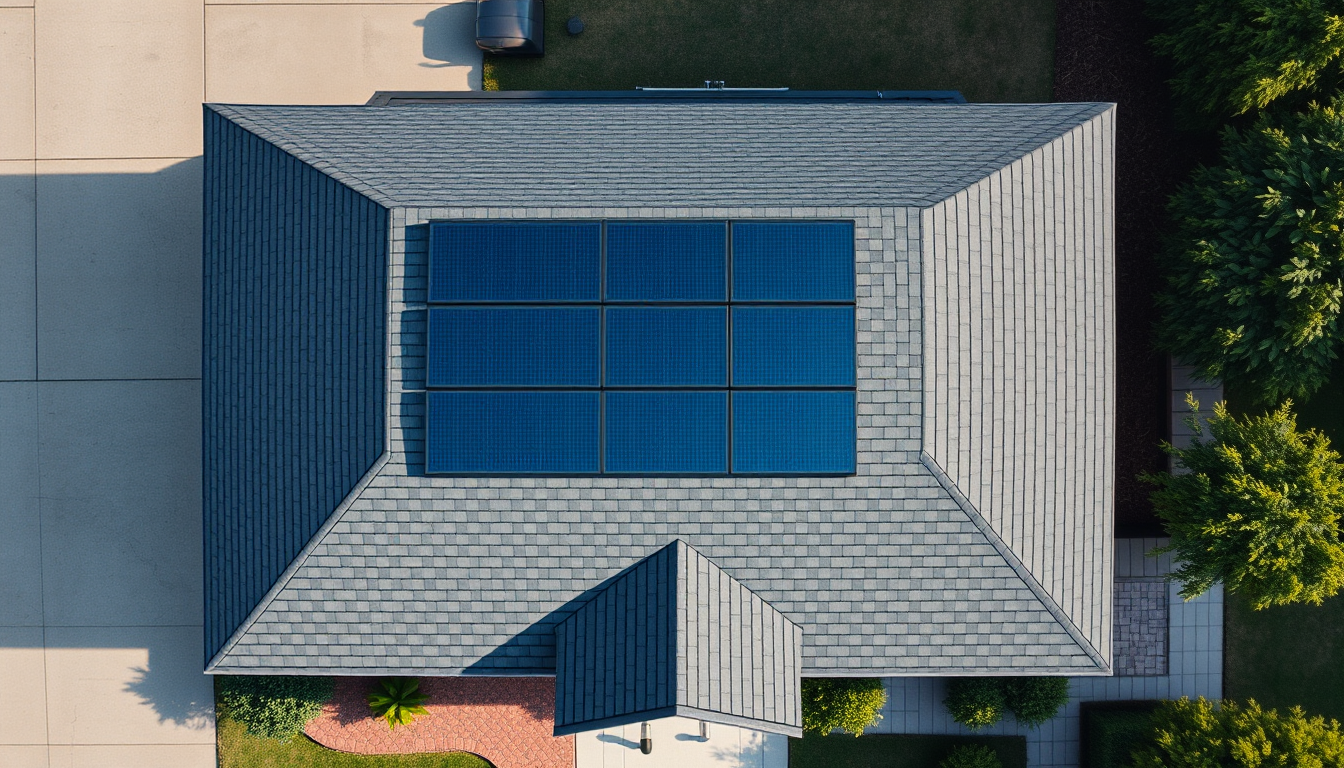
A modern residential panel covers about 22 to 25 square feet (a standard module is roughly 65 by 39 inches, or 17.5 square feet). Then you need extra space for fire-code setbacks, walkways, and obstructions like vents and chimneys. Most jurisdictions require a safety path around the roof edge that eats up roughly 25% of the usable roof area.
A quick capacity check: take the usable square footage of your roof, multiply by 0.75 for setbacks, and divide by 17.5 to estimate the maximum panel count. A 1,000 square foot roof, for example, fits roughly 43 panels at that math.
Orientation changes the number too. Relative to a true south-facing roof: southeast or southwest runs about 90 to 95% of baseline, east or west about 75 to 85%, and a north-facing face usually only 55 to 70% (generally worth it only as fill-in). Tilt is less of a lever than people think. Being 10 to 15 degrees off the ideal pitch typically costs only 2 to 5% of annual output, rarely enough to justify tilt frames.
Why the exact number is your address, not your state
Notice what the formula is really asking for: your actual annual usage, your actual zip code, your actual roof orientation, and your actual shading. Every one of those is specific to your house. A national average or a state average is a starting point, not an answer. The difference between "I live in New Jersey" and "my south-facing roof in that particular town gets X hours of usable sun and has a chimney shadowing the west half" is often several panels and several thousand dollars of savings.
If you want the real number for your home without a sales call, the fastest way is to run a satellite scan at https://solrscan.com for $19. It reads your exact address and gives you the sunshine hours for that roof, the number of panels that fit, the recommended system size and install cost, and the projected yearly savings. That report is the input list for this very formula, filled in for your house, so the next quote you get lands somewhere you can actually judge.
Sources
- SolarBazaar, "Solar Panel Calculator: How to Work Out Exactly How Many Panels You Need" (sizing formula, derate table, worked examples)
- The Green Watt, "Average Peak Sun Hours by State: All 50 + DC (2026)" (NREL PVWatts v8 state averages)
- Solar Permit Solutions, "Roof Space Requirements For Solar Panels" (panel dimensions, setback math, capacity formula)
- U.S. Energy Information Administration, "Electricity use in homes" (average household annual consumption)
SolrScan estimates are based on satellite imagery and public data. Consult a licensed installer for a site-specific assessment.