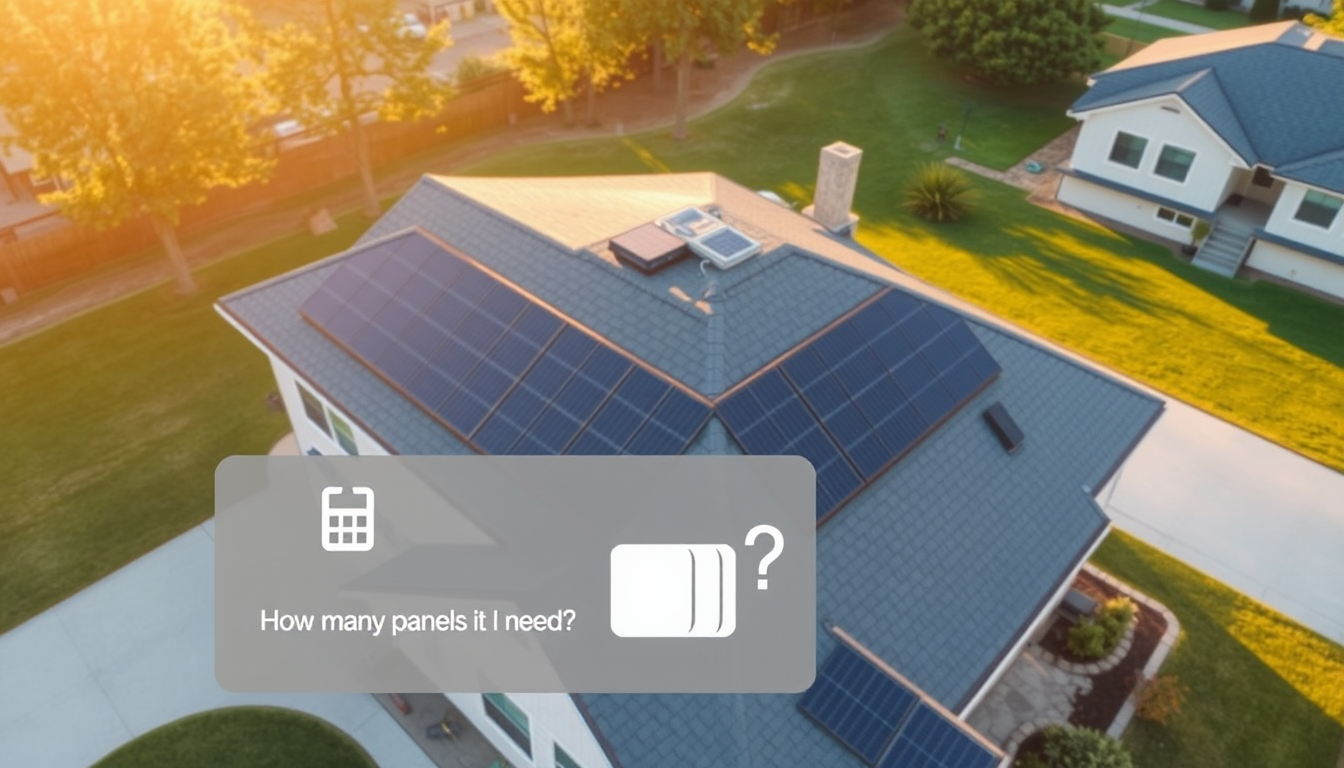
How Many Solar Panels Do You Actually Need? (The Real Formula, With 2026 Numbers)
How many solar panels does your home need? The real answer is 3 numbers: your 12-month usage, your ZIP code's peak sun hours, and your actual usable roof space. Here's the exact formula, with 2026 numbers by state.
The one question every homeowner asks first
"How many solar panels do I need?"
It's the first thing people want to know, and it's the first thing a $19 scan at SolrScan will tell you. But before you pay a salesperson $0 for a "free estimate," it's worth knowing the actual math. It's simpler than you'd think, and it comes down to three numbers: how much power you use, how much sun your ZIP code gets, and how much roof you actually have.
None of this requires a 90-minute pitch. Here's the honest formula.
Start with your utility bill, not your roof
The single biggest mistake in solar sizing is staring at your roof and guessing. The real starting point is your electricity usage.
The average U.S. household uses about 10,500 kWh of electricity per year, according to the U.S. Energy Information Administration. That's roughly 875 kWh a month. This is the number that sets the floor under everything else. If you use less, you need fewer panels. If you run an EV charger, a heat pump, or a pool, you need more.
The rule that matters most: use 12 months of bills, not one good month. A mild July bill will underbuild your system. A cold December will overbuild it. Average a full year.
The sizing formula (it's just division)
Installers and engineers use a simple calculation. You can do it with a phone calculator:
System size (kW) = annual kWh / (365 x peak sun hours x 0.80)
The 0.80 is a derate factor. It accounts for inverter losses, wiring, and the fact that panels run hotter and less efficiently in the real world than in a lab. It's a planning assumption, not a promise.
Let's run it for the average home using 10,800 kWh a year at 5 peak sun hours:
10,800 / (365 x 5 x 0.80) = 7.4 kW
A 7.4 kW system at 400-watt panels is about 19 panels (7,400 / 400 = 18.5, round up). That's the "19 panels" you'll hear quoted for a typical U.S. home.
The number nobody puts in free calculators: peak sun hours
Here's where two identical houses end up needing completely different systems, and where most free online tools quietly fail. Peak sun hours vary by ZIP code, and they matter more than anything else.
A peak sun hour is one hour of full-strength sunlight (1,000 W/m²). Phoenix gets about 6.5 a day; Seattle-area Washington gets about 4.0. That's a 60%+ difference in daily energy from the exact same panel.
Real 2026 NREL data, peak sun hours per day:
| Location | Peak sun hours | Annual kWh per 1 kW | |---|---|---| | Arizona | 6.54 | ~1,755 | | California | 6.08 | ~1,677 | | Colorado | 5.66 | ~1,595 | | Florida | 5.48 | ~1,455 | | Texas | 5.22 | ~1,421 | | U.S. average | 4.98 | ~1,400 | | New York | 4.50 | ~1,291 | | Washington | 3.95 | ~1,088 |
So a 900 kWh/month home in a sunny 6-hour zone needs roughly 16 panels. The exact same home in a 4-hour zone needs about 24. Same bills, same roof, 8 more panels. Free calculators that ignore your ZIP code get this wrong.
Quick reference by monthly usage (400W panels, 5 sun hours)
| Monthly usage | System size | Panels | |---|---|---| | 300 kWh | 2.5 kW | 7 | | 600 kWh | 4.9 kW | 13 | | 900 kWh | 7.4 kW | 19 | | 1,200 kWh | 9.9 kW | 25 |
Higher-wattage panels cut the count. A 7.4 kW system is 19 panels at 400W but only about 17 at 440W. More watts per panel means fewer of them and less roof space used for the same output.
The real constraint: your roof, not your bills
Here's the part the math above can't tell you. You can calculate that you need 19 panels for your usage, but if your roof only has unshaded space for 14, that's the number you can actually install.
This is the gap that a satellite scan is built to close. The formula tells you what your bills say you need. Only an actual look at your roof tells you what you can fit, where the shade falls, and whether your orientation is working for you or against you.
What to actually do
You have three options, and only one costs $19:
- Guess from an online calculator. Free, but it usually skips your ZIP code and never sees your roof.
- Book a "free" installer estimate. You'll get a number, and then a 45-minute sales conversation.
- Run a $19 satellite scan at SolrScan. It reads the satellite imagery for your exact address and hands back how many panels actually fit, your annual sunshine hours, your recommended system size and wattage, and the projected savings. No phone call, no pressure, no commitment.
The math is simple. Your specific roof is the variable only a scan can see.
Want to know your number for your actual address? Run the $19 satellite scan at https://solrscan.com and see how many panels your roof can really take.
SolrScan estimates are based on satellite imagery and public data. Consult a licensed installer for a site-specific assessment.