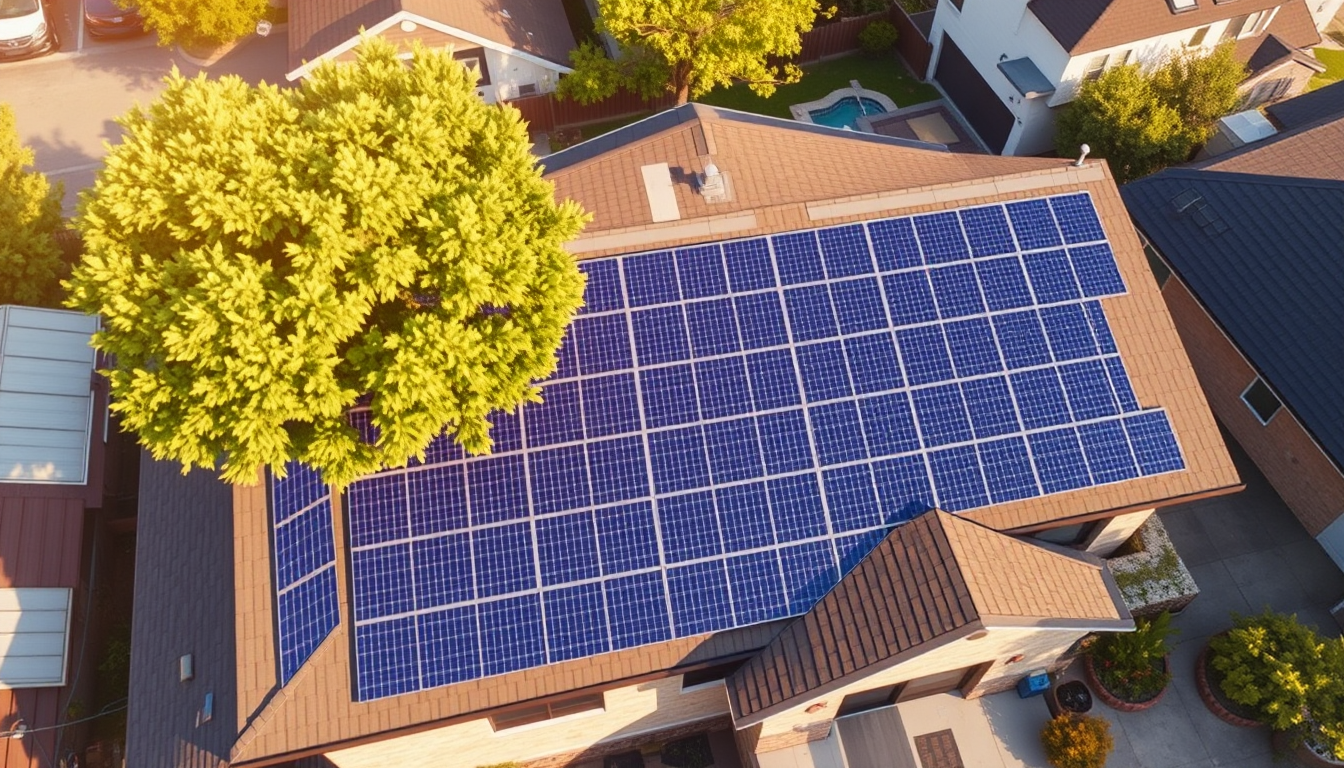
How Much Are Trees and Chimneys Costing Your Solar Panels? (The Shade Math Installers Hope You Skip)
Shade is the #1 reason solar systems underperform, and a single shaded panel can drag down an entire string. Here is the real math on how much you lose, when it actually matters, and the fix that often saves hundreds of dollars a year.
Most homeowners walk into a solar conversation with a list of fears: the cost, the paperwork, whether the panels will look ugly. But the single biggest threat to the money you actually save is something almost nobody raises first: shade.
A tree branch over the roof edge. A chimney in the middle of the array. A neighbor's fence or a dormer that was fine in the photos. Shade is the most common reason a system that looked great on paper quietly underdelivers for the next twenty-five years.
Here is what the data says about how much you are really losing, and what actually fixes it.
The one rule that surprises people: one shaded panel can hurt the whole string
The way most residential systems are wired matters a lot. Panels are connected in "strings," and a standard string inverter reads the entire string as one unit. Think of it like a chain. Every link in a chain is only as strong as the weakest link.
Solar works the same way. The panels in a string share the same current. So when one panel is shaded, it does not just lose its own power. It drags the output of every other panel on that string down with it.
A concrete example from field data: a string of ten panels, each putting out 400 watts in full sun, makes 4,000 watts. Now one panel gets about half shade. Its output collapses to roughly 80 watts (the bypass diodes built into the panel kick in, but only partially). Because of the shared current, the whole string drops to around 3,200 to 3,400 watts. That is a 15% to 20% loss from a single panel.
This is the trap. The estimate you get is usually based on a "typical" production number. It does not automatically account for the specific chimney that will shade your third panel at 11 a.m. every single day.
The four kinds of shade (and which ones actually matter)
Not all shade is equal. Installers and shading tools sort it into a few categories, and the timing is what makes a big difference.
1. Passing clouds and haze. This is soft, transient shade. It costs 2% to 8% a year depending on your climate. Phoenix loses maybe 2% to 4% (300+ sunny days). Portland or Seattle can lose 12% to 18%. There is nothing you do about this. It is already baked into any good local production model. Do not pay extra to "fix" it.
2. Fixed soft shade from distant objects. A tree in the next yard, or a neighbor's roof, casting a soft, slow-moving shadow. This is where it starts to add up: 5% to 18% a year. If two or three panels sit in partial shade for a few hours a day, you are looking at a double-digit loss.
3. Fixed hard shade (the real enemy). A chimney, vent pipe, dormer, or nearby building that throws a sharp, solid shadow on one or more panels. A small chimney shading one panel for two hours can cost 6% to 10% a year. A big dormer shading three panels for four hours can cost 20% to 28%. This is the type that quietly wrecks a payback period, and it is the type that a good layout design can work around.
4. Seasonal hard shade from leafy trees. This one reverses on itself. The tree is bare in winter (low production) but fully leafed in summer (peak production). So the shade hits exactly when you would make the most electricity. The loss can range from 15% to 40% a year.
The pattern: shade during your peak production hours costs far more than the same amount of shade at the wrong time. That is why "it only shades in the afternoon" can still be expensive.
The number that tells you if your roof is worth it
Professional shade tools (PVWatts, Aurora Solar, Sunmetric SunEye) roll tilt, orientation, and shade into a single score called TSRF. It is basically a percentage: how much of the ideal solar resource your actual roof captures.
The practical thresholds:
- TSRF 96% to 100%: ideal site. 0% to 4% loss. A standard string inverter is fine.
- TSRF 90% to 95%: excellent. 5% to 10% loss. String inverter still works.
- TSRF 85% to 89%: good but shaded. 11% to 15% loss. This is where you should be asking about microinverters or power optimizers.
- TSRF 80% to 84%: acceptable, 16% to 20% loss. MLPE strongly recommended.
- TSRF 75% to 79%: marginal. 21% to 25% loss. MLPE strongly recommended.
- TSRF 70% to 74%: poor. 26% to 30% loss. Consider redesigning or repositioning.
- Below 70%: very poor for rooftop. 31% to 35%+ loss. A ground mount may beat a roof.
The rule of thumb: 90% and above, a string inverter is acceptable. 75% to 89%, use MLPE (microinverters or optimizers). Below 75%, rethink the design.
What it actually costs in dollars
Here is the 25-year math that installers rarely spell out. At a 4% annual electricity rate increase and a 3% discount rate, losing $500 a year to shade has a present value of about $11,400 over the life of the system. Losing $800 a year is about $18,240.
So a "small" shade issue is not small over twenty-five years. On a 10 kW system in a higher-rate state, the gap between an 85% site and a 75% site can be $700 to $1,000 a year in lost value.
The fix that is usually cheaper than you think: microinverters
Here is the good news. The electronics can recover a big chunk of shade loss, and the math usually works.
On a 10 kW system with moderate shade on a couple of panels:
- String inverter (no MLPE): 78% to 83% of unshaded production. That is a 17% to 22% loss.
- Power optimizers (SolarEdge): 87% to 91%. A 9% to 13% loss.
- Microinverters (Enphase): 88% to 92%. An 8% to 12% loss.
The reason: MLPE gives each panel its own independent power tracking. A shaded panel loses only its own output and does not drag the rest of the array down.
The economics on a 10 kW system in a ~31-cent state: the MLPE premium is roughly $3,000 (about $300 per kW over a string setup). The recovered production is about $516 a year. That puts the payback at around 5.8 years, and the MLPE recovers roughly $12,900 in electricity value over the system life. In many cases, the extra cost pays for itself.
The honest caveat: microinverters reduce mismatch losses. They cannot create sunlight. If the shade is severe and permanent, a cleaner layout, a repositioned obstruction, or a ground mount will outperform a clever set of electronics. The best fix is often the boring one: put the panels where they actually get sun.
The four questions to ask before you sign
-
Did you measure shade on site, or only from aerial imagery? A satellite photo cannot see a low branch or a vent that only matters at a specific sun angle.
-
What is my TSRF or shade-loss score, and how does the annual production change if I remove the shaded section from the design? If a proposal does not change when you remove the shaded panels, you are not being shown the real tradeoff.
-
Which inverter type am I getting, and why that one on a roof with this much shade? An unexplained string inverter on a partially shaded roof is a red flag.
-
What is the plan for the trees? Trimming is not automatically the right answer. It has a cost, ongoing maintenance, and local rules. Sometimes a smaller, clean array beats a bigger one that depends on aggressive trimming every year.
And one more red flag: a big production number with no shade report attached. That is the estimate that looks great in the driveway and disappoints in the monitoring app.
Check your own roof before you pay someone to guess
The fastest way to see whether your specific address is a strong solar candidate is not a sales call or a zip-code average. It is an actual look at your roof.
At https://solrscan.com you can scan your own home's address and get the numbers that matter for the shade conversation: your address's annual sunshine hours, how many panels and how many watts will actually fit, the estimated system size and installation cost, and your projected energy savings. It is $19, and it is just the scan. No salesperson, no driveway visit, no pressure.
Bring those numbers into the quote conversation. Now when an installer talks about your roof, you can ask the specific question instead of guessing: "given my roof's actual sun, how much is that tree or chimney costing me, and what is your TSRF?"
That is the difference between signing a number and signing a plan for your specific house.
SolrScan estimates are based on satellite imagery and public data. Consult a licensed installer for a site-specific assessment.