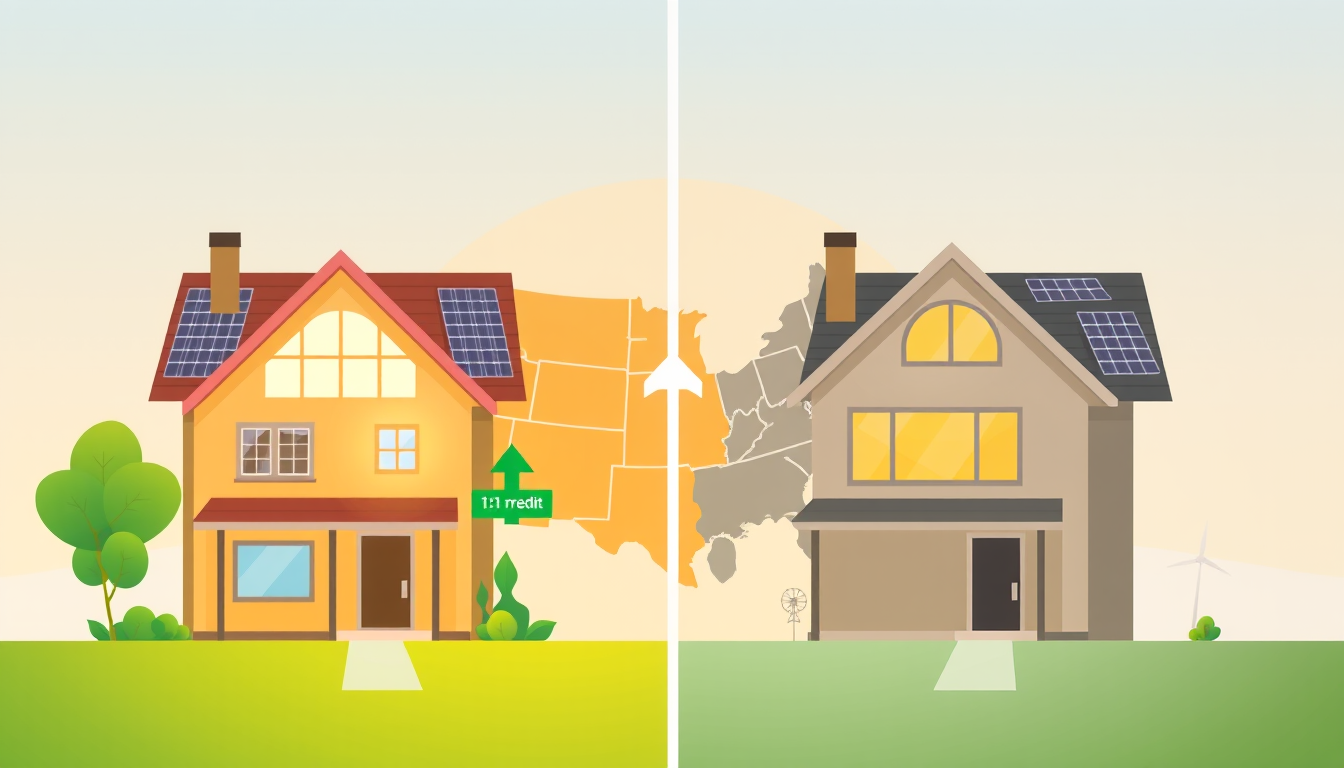
Net Metering in 2026: What Your Utility Actually Pays You for Solar (and Why Your State Changes Everything)
After the federal residential tax credit expired in December 2025, net metering is the single biggest driver of solar payback. Here are the four compensation structures, which states use each, and how to check what your utility will actually credit you for every kilowatt-hour your panels export.
Here's the uncomfortable truth that most solar sales pitches quietly skip: the number that decides whether your solar system pays for itself in 7 years or 14 years is not the panel price, not the installer, and no longer even the federal tax credit. It's a number you probably have never seen.
It's your utility's export credit rate. And it depends almost entirely on where you live.
The federal residential solar tax credit (the 25D/30% credit) expired on December 31, 2025. That removed a chunk of subsidy that had been smoothing over the real economics for a lot of homeowners. What's left is the raw deal between your roof and your utility, and that deal is set by your state, not by Washington.
What net metering actually is (and isn't)
At its simplest: your utility installs a two-way meter that measures both the electricity you pull from the grid and the electricity your panels push back in. At billing time, the utility nets the two and charges you on the difference.
The one detail that matters enormously is what rate your exported electricity is credited at. That single rate is the whole game.
Three things net metering is not, despite constant confusion:
- It is not federal policy. It exists because of state public utility commission (PUC) rules. Federal law (the 1978 PURPA framework) just lets states require utilities to buy exports; the rates are set state by state.
- It is not a subsidy. The utility isn't handing you money. You're getting credit for electricity you supplied to the grid.
- It is not universal or uniform. Roughly 44 states plus DC have some form of export compensation, but the specifics vary so much that "I have net metering" is basically meaningless without a state attached.
The four structures you'll actually encounter
Strip away the marketing terms and there are really four ways your exports get paid in 2026:
1. Full retail (1:1) net metering
Every kilowatt-hour you export earns a credit equal to the full retail rate you pay to import. Credits usually roll month to month, and annual unused credits settle at retail (best case) or avoided cost. This is the gold standard for solar economics, and it was the dominant US policy through about 2015.
2. Retail with modifiers
Credit at retail for most exports, but with tweaks: lower credit for surplus beyond your annual usage, time-of-use splits, or program caps on how many customers can join. Common in parts of Texas (retail buyback plans), New York's VDER, Vermont, and Maine.
3. Net billing / value-of-solar tariffs
Exports are credited at a separately set rate that's typically well below retail, reflecting the utility's "avoided cost" of generation (roughly 3 to 8 cents/kWh) or a calculated "value of solar." This is California's NEM 3.0, Arizona, Hawaii, Michigan, and a handful of others. Under these rules, self-consumption (and often a battery) becomes the strategy.
4. No net metering or avoided cost only
Exports earn nothing, or only the utility's avoided cost with no retail adder. You'll find this in parts of South Carolina, Tennessee (TVA territory), South Dakota, and Alabama (avoided cost plus a monthly solar fee). Solar still works here, but only if you use most of your own power, usually with a battery.
What your state actually pays you in 2026
This is where it gets concrete. The same 7 kW system on the same roof can have a very different life depending on the utility behind your meter:
Full retail (1:1), the best case
- New Jersey: 1:1 retail plus a strong SREC successor program. One of the best overall deals in the country.
- Maryland, New York, New Jersey, Colorado: 1:1 retail, credits roll forward, stack with additional SREC/incentive programs.
- Massachusetts: 1:1 up to 10 kW, credits never expire, plus the SMART incentive on top.
- Florida (co-ops), Washington, Oregon, Virginia, Minnesota, Montana: full retail intact. Virginia's SCC rejected Dominion's cut in April 2026; Washington's terms are guaranteed until utility caps or June 2029.
Net billing / reduced credit, the hard case
- California (NEM 3.0): hourly export rates averaging about 5 to 8 cents/kWh versus retail rates of 25 to 40 cents/kWh. Appeals courts upheld NEM 3.0 in March 2026. A battery is effectively required for good economics here.
- Arizona: Resource Comparison Proxy around 3 to 6 cents, locked 10 years, stepping down annually for new sign-ups.
- North Carolina, Illinois, Michigan, Idaho: all moved to net billing with reduced exports. Idaho's cut was a 31% reduction that took effect September 2025. Illinois ended full-retail net metering for systems energized after January 1, 2025.
No meaningful export credit
- Tennessee (TVA), South Dakota, Alabama: avoided cost only (2 to 4 cents) or nothing, sometimes with a monthly solar fee on top.
Why this changes your whole decision
Because the export credit is the make-or-break input, a system that's a slam dunk in one state can be a marginal call in the next one over. In a full-retail state, exporting is basically as valuable as using, so you can size your system to produce more than you consume. In a thin-credit state, every exported kilowatt-hour is worth only a few cents, so the value of your system comes almost entirely from the power you use yourself during the day. That single fact reshapes how big a system to buy, whether a battery makes sense, and what your payback looks like.
Two practical consequences:
- Where policy is tightening, locking in now often grandfathers you at today's better rate for 10 to 25 years. In Virginia, systems connected before the deadline are protected. In California, pre-April-2023 interconnections keep the old tariff. If your state has a reduction pending, the math on waiting gets worse fast.
- Self-consumption is the universal hedge. No matter where you are, the power you use the moment it's made is the most valuable power you'll ever get. Matching your daytime usage to your production (or storing it) is the part of the deal that's identical everywhere.
How to check your own situation
You can't get this number from a generic quote. Here's what to do:
- Find your exact utility and rate plan (it's on your bill).
- Look up your state and utility in the DSIRE database (maintained by the NC Clean Energy Technology Center), the authoritative primary source on export compensation.
- Confirm the current export credit rate and whether your state has any pending changes.
- Then size your system around your export rate and your daytime usage.
That last step is where most people get it wrong, because a standard estimate assumes an average state and an average roof. Your roof is not average.
The export rate is a state-level fact, but the other half of the equation is address-specific: how much sun your actual roof catches, how many panels it physically fits, and how much of that you'd realistically use versus export. Those are the inputs that turn a state-level policy into your real payback.
Scan your home at https://solrscan.com and you'll get the exact sunshine hours for your address, the number of panels and system size that actually fit your roof, and your projected energy savings. That $19 report gives you the address-specific numbers to plug into your state's export rate, so you're making the call on your roof and your utility, not a national average.
SolrScan estimates are based on satellite imagery and public data. Consult a licensed installer for a site-specific assessment.